Tag Archives: elocutio

Appositio

Appositio (ap-po-sit’-i-o): Addition of an adjacent, coordinate, explanatory or descriptive element.


I stood by the big gray rock—a fixture on the farm—possibly as old as Earth. Isolated as a child, far from town, no television, no neighbors for 10 miles, no pets, no friends, the big brown rock sort of became a source of solace. That is, when I was with it I felt like I was in the company of something that had consciousness. It didn’t talk. It didn’t move. It didn’t gaze.

I didn’t tell anybody about the big brown rock. I would have been put under observation in the insane asylum in Brisbane. 20 years ago, the big brown rock was struck by lightning. A bunch of small pieces—stones—were chipped off by the lightening. 10 years ago on a visit, I picked up a stone and put it in my pocket. I’ve been carrying it in my pocket ever since. When people ask me why I always have “that stone” in my pocket, I tell them “l don’t know.” It’s true, I don’t know, and I don’t want to know.


Definition courtesy of “Silva Rhetoricae” (rhetoric.byu.edu)

Paper and Kindle versions of The Daily Trope are available at Amazon under the title The Book of Tropes.
Ara

Ara (a’-ra): Cursing or expressing detest towards a person or thing for the evils they bring, or for inherent evil.


I can’t find any way around it. I hate you. I hate you as much as I will revel in your death—cold, hard, lonely suffering. You were supposedly called by God when you became a Christian priest. But you were not called by anything except your perverse sexual desires .

You are morally rotted: befriending, grooming and teaching: not history or math, but Depravity 101. You should be chopped apart while you are awake—your legs cut into cubes of meat and thrown into a dumpster to be scavenged by wild animals.

I hate you for what you did me and all the others. I hope you are beaten senseless every day in prison. I hope you are murdered and cremated and your ashes flushed down a toilet or scattered over a landfill. I hate you.


Definition courtesy of “Silva Rhetoricae” (rhetoric.byu.edu).

Paper and Kindle versions of The Daily Trope are available from Amazon under the title of The Book of Tropes.

Articulus

Articulus (ar-tic’-u-lus): Roughly equivalent to “phrase” in English, except that the emphasis is on joining several phrases (or words) successively without any conjunctions (in which case articulus is simply synonymous with the Greek term asyndeton). See also brachylogia.

Articulus is also best understood in terms of differing speeds of style that depend upon the length of the elements of a sentence. The Ad Herennium author contrasts the the slower speed of concatenated membra (see membrum) to the quicker speed possible via articulus.


Time, Hell, money, truth. There is no semblance of leisure here on the edge. Here, where everything I know is past. The future? Never. The present? Fleeting: a small dessert eaten while standing up.

Paris. London. Madrid. I am seeking refuge from the silence and the moon. Call me. Show me you care.


Definition and commentary courtesy of “Silva Rhetoricae” (rhetoric.byu.edu).

Paper and Kindle versions of The Daily Trope are available on Amazon under the title The Book of Tropes.

Aschematiston

Aschematiston: The use of plain, unadorned or unornamented language. Or, the unskilled use of figurative language. A vice. [Outside of any particular context of use or sense of its motive, it may be difficult to determine what’s “plain, unadorned or unornamented language.” The same is true of the “unskilled use of figurative language.”]


1. This is a mess. You spilled your milk and dumped your Spaghettios on the floor. I’m going to pretend I never saw this, but you should consider heading back to Kentucky and working as a school crossing guard or something like that. What do you think, Mitch?

2. The sky is a sponge squeezing it’s juice on the peanut butter earth: like a forked wing flying around in circles spitting invisible lice into the air, it rains down a blood-sucking shower of Truth.


Paper and Kindle versions of The Daily Trope are available at Amazon under the title The Book of Tropes.


Definition courtesy of “Silva Rhetoricae” (rhetoric.byu.edu). Bracketed text added by Gorgias.

Asphalia

Asphalia (as-fay’-li-a): Offering oneself as a guarantee, usually for another.


I have been a fry-cook for 22 years. I’ve flipped more burgers than any single McDonalds, Burger King, or Wendy’s. Ok, that’s an exaggeration, but it is close to true. I taught Elrond, my son, all he knows, and I believe his prowess as a fry-cook surpasses mine. In addition to burgers, he can do omelettes and steaks, and oysters, and much, much more. Additionally, Elrond is easy-going and gets along well with other people.

I hope you would consider him for the fry-cook position that just opened. I will mentor him and see to it that he does well. I’ve been working here for the past 9 years. I know I’ve earned your trust. If Elrond does not work out, I’ll resign. I am confident that won’t happen, but I swear I will leave.

See you later!


Definition courtesy of “Silva Rhetoricae” (rhetoric.byu.edu).


Paper and Kindle versions of The Daily Trope are available from Amazon under the title The Book of Tropes.

Assonance

Assonance (ass’-o-nance): Repetition of similar vowel sounds, preceded and followed by different consonants, in the stressed syllables of adjacent words.

Divided all along days and nights of debauchery and prayer, my battered soul battles itself in fits of shame and solace—like a cordless blinker hotly flashing my travails.

Definition courtesy of “Silva Rhetoricae” (rhetoric.byu.edu)

Paper and Kindle versions of The Daily Trope are available at Amazon under the title The Book of Tropes.

Assumptio

Assumptio (as-sump’-ti’o): The introduction of a point to be considered, especially an extraneous argument.

See proslepsis (When paralipsis [stating and drawing attention to something in the very act of pretending to pass it over] is taken to its extreme. The speaker provides full details.).

I’m not going to talk about the killing, the wanton destruction of government property, and basically, the display of anti-democratic abandonment by the Capitol’s invaders. Their numbers and their concerted common cause demand that we find the roots of their solidarity and cut them off as soon as humanly possible.

But all this goes without saying. What really matters is the public discourse that captured their minds and turned them away from democracy’s demand for reasonable and respectful deliberation. Evidently, they were motivated by baseless (lying) repetitive assertions that the elections were rigged, and by a three-word slogan: “Stop the Steal!” On this basis, eschewing reason and evidence, they did what they did—they stormed the Capitol with malice in their hearts.

What we need now, most importantly, is to set up a commission to discover how and why the invaders were prompted by baseless assertions and an accompanying three-word slogan—discourses that may rightfully influence children, but should not influence educated adults. We need to understand this new ‘means of persuasion’ and put groundless assertions and their accompanying slogans back where they belong: in a barrel marked “TOXIC WASTE”, not for their substantive claims, but for their failure to abide by norms of deliberation that constitute informed viewpoints across Democracy’s diverse spectrum of belief. Somehow we must sanction foundational lies and their destructive purveyors. This is an emergency.

Definition courtesy of “Silva Rhetoricae” (rhetoric.byu.edu).

Paper and Kindle versions of The Daily Trope are available from Amazon under the title The Book of Tropes.

Asteismus

Asteismus (as-te-is’-mus): Polite or genteel mockery. More specifically, a figure of reply in which the answerer catches a certain word and throws it back to the first speaker with an unexpected twist. Less frequently, a witty use of allegory or comparison, such as when a literal and an allegorical meaning are both implied.

Don: The election was stolen.

Normal Person: From where I’m sitting, it looks like your sanity was stolen.

Definition courtesy of “Silva Rhetoricae” (rhetoric.byu.edu)

Paper and Kindle versions of The Daily Trope are available at Amazon under the title The Book of Tropes.

Asyndeton

Asyndeton (a-syn’-de-ton): The omission of conjunctions between clauses, often resulting in a hurried rhythm or vehement effect. [Compare brachylogia. Opposite of polysyndeton.]

Hope, faith, charity: the tines of a dull rake tearing at my heart with their scathing absence. I am unable, unwilling, uninvited: unhopeful, unfaithful, uncharitable. I fear. I scoff. I take. There is no forgiveness from anybody anywhere that assuages blunders, bad choices, wrong turns. Only time and forgetting clear the way. But still, we are doomed by our moral compass to navigate toward the abyss. The darkness. The infinite. The void. The end.

Definition courtesy of “Silva Rhetoricae” (rhetoric.byu.edu). Bracketed text added by Gorgias.

Print and Kindle versions of The Daily Trope are available from Amazon under the title The Book of Tropes.

Auxesis

Auxesis (ok-see’-sis): (1) Arranging words or clauses in a sequence of increasing force. In this sense, auxesis is comparable to climax and has sometimes been called incrementum. (2) A figure of speech in which something is referred to in terms disproportionately large (a kind of exaggeration or hyperbole). (3) Amplification in general.

(1) We are born. We crawl. We walk. We run. We never get there. Life is like a dull knife—more likely to fatally cut you than a well-sharpened piece of steel, as you push its chipped edge forward and try to carve out your desired future, it slips out of time and guts you.

(2) My credit card is like a license plate affixed to a red limo going 125 MPH toward the gates of Heaven. It vibrates with luxury, fine dining, and gold. It is my partner, my joy, my dream come true, until the end of the month when I cut it up and steal a new one.

Definition courtesy of “Silva Rhetoricae” (rhetoric.byu.edu).

Print and Kindle versions of The Daily Trope are available from Amazon under the title The Book of Tropes.

Bdelygmia

Bdelygmia (del-ig’-mi-a): Expressing hatred and abhorrence of a person, word, or deed.

Utilize. Where the hell did utilize come from? Why not just say “use?” The people who use utilize instead of use, use a Latinized version of a simple word: “ize” gives the little word bigness, importance, status. At least that’s what the word’s users think. Idiots. Twits. Losers. When I hear it, I hate it, the hatred rubs off on the users of utilize.

Definition courtesy of “Silva Rhetoricae” (rhetoric.byu.edu).

A version of The Daily Trope is available from Amazon in print and Kindle formats under the title The Book of Tropes.

Bomphiologia

Bomphiologia (bom-phi-o-lo’-gi-a): Exaggeration done in a self-aggrandizing manner, as a braggart.

When the election was stolen from me, I was a little upset. My followers were so upset, out of love for me and my amazing leadership talent, they decided to stage a coup (all on their own). Given their undying affection, they moved. They beat police with flagpoles and a couple fire extinguishers and concealed clubs: all they did was look at me, downtrodden and jacked around, and their anger spontaneously flowed.

They love me, worship me, and have faith in me like their savior. I am their savior. Maybe they’ll riot. Maybe they’ll kill Biden. It won’t be my fault. I am beautiful and they love me.

Definition courtesy of “Silva Rhetoricae”

A version of The Daily Trope is available from Amazon under the title The Book of Tropes.

Brachylogia

Brachylogia (brach-y-lo’-gi-a): The absence of conjunctions between single words. Compare asyndeton. The effect of brachylogia is a broken, hurried delivery.

Tired. Hungry. Crazy. I peek out the broken window—the window broken by a single shot fired from across the street. It has finally happened—goddamn—another bullet whizzes through the window, killing the cat and lodging in the floor. My daughter cries uncontrollably. My wife stands up and moves toward the window yelling, “Who the fuck are you? What the fuck are you doing? What do you want?” She’s answered by a clean shot to the forehead, killing her instantly. My daughter and I will be dying soon and we know it. Regretful. Terrified. Resigned. We look out the window and silently wait.

Definition courtesy of “Silva Rhetoricae” (rhetoric.byu.edu)

Paperback and Kindle versions of the Daily Trope are available on Amazon.

Cacozelia

Cacozelia (ka-ko-zeel’-i-a): 1. A stylistic affectation of diction, such as throwing in foreign words to appear learned. 2. Bad taste in words or selection of metaphor, either to make the facts appear worse or to disgust the auditors.

I felt the parameters of my television crumble when my streaming box went slo-mo into a pantheon of stretched words and images. It was like floating on a sea of hardening cement with a stingray protruding from my crusted trousers. My soul filibustered my body’s ganglia. My eyes started watering and I snapped back only to find my goldfish Karma 27 crushed on the floor, eyeballs protruding like black and grey glass balls

Definition courtesy of “Silva Rhetoricae” (rhetoric.byu.edu).

The Daily Trope is available on Amazon in paper and Kindle formats under the title Book of Tropes.

Effictio

Effictio (ef-fik’-ti-o): A verbal depiction of someone’s body, often from head to toe.

Note: This figure was used in forensic rhetoric (legal argumentation) for purposes of clearly identifying an alleged criminal. It has often been adapted to poetical uses.

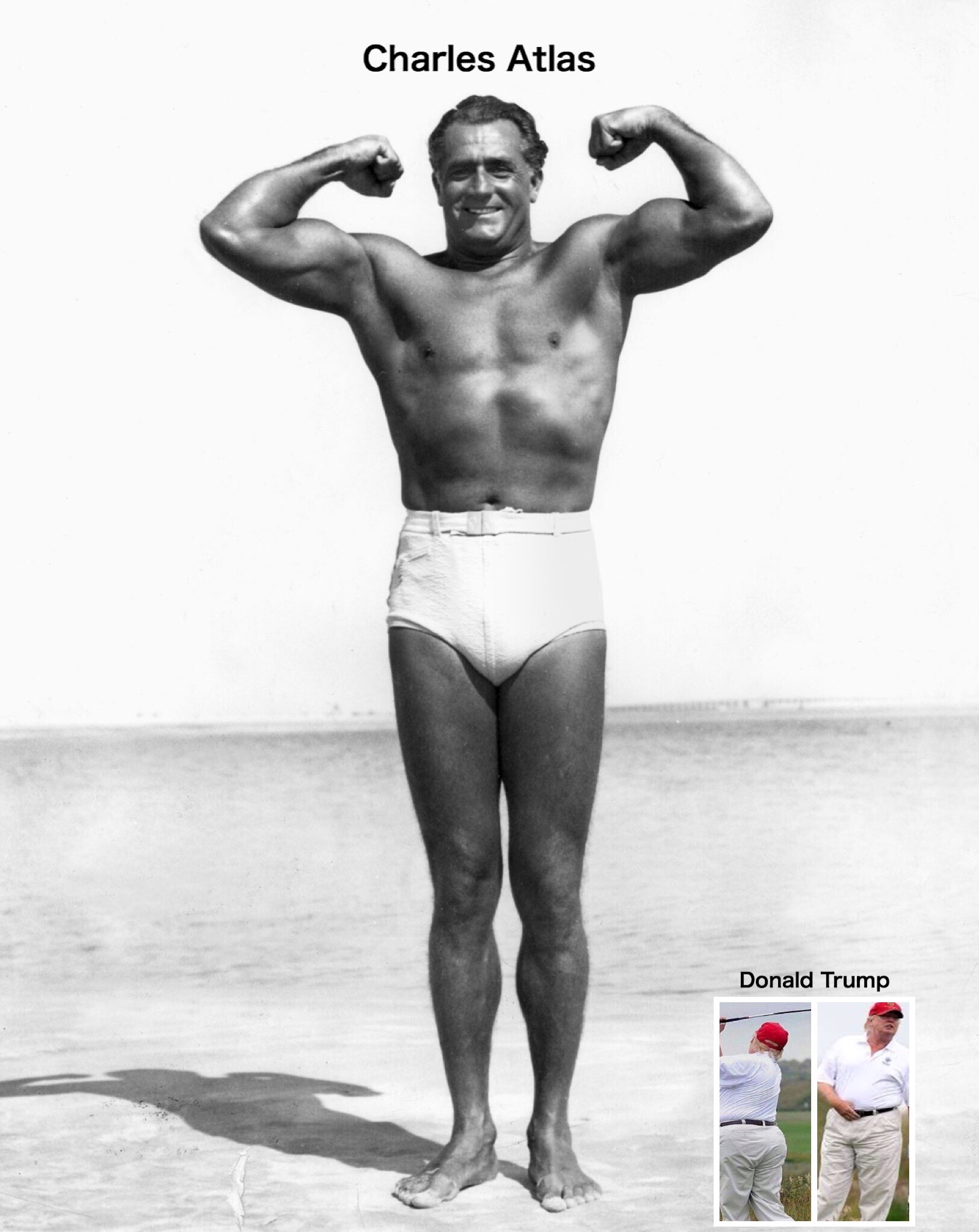
His dyed blond hair is frozen by hairspray into a combination of a rolling wave and a Dairy Queen. His face and tiny hands are covered with bronzing cream making them look like a too-thick cadaver paint job performed by an angry mortician. His eyes are dull blue like spun aluminum moon hubcaps from the sixties. His mouth looks like a banana, peeled, cut sideways, and dyed with Red Dye 40. His teeth look like stunted piano keys superglued to his gums. His neck has a turkey wattle that swings in the wind. In calm weather it looks like labia. His loosely fitting white golf shirt can’t hide his robust boobs with little man-sized nipples pointing the way to the next faux pas. His watermelon belly is suggestive of an early pregnancy. He has an ass the size of North Carolina. It sticks out at right angles to his back. It actually provides a shelf that nobody dares to set anything on except envelopes filled with cash. His penis has been characterized as a “little mushroom” however there is some controversy over whether it looks more like a little toadstool. Having never seen it myself, I can’t say one way or the other, but I think “mushroom” is probably more accurate, given the source. In any event, “little” is the operative term. Legs and feet are what you would expect: legs like flabby gyros ready for the rotating spit; feet a bone spur museum curated by a crooked doctor from New York: try to find the bone spurs.

All-in-all this man’s appearance is a parody of Charles Atlas, the famous 1960s body builder whose image plagues old men with his tanned bodily perfection; old men who never made the mark.

Who is this man who still longs for the Charles Atlas look–who unsuccessfully uses hair and skin dye to approximate his boyhood hope? Who is unable to do anything below his neck to camouflage his failure? He is the President of the United States, Donald Trump.

Definition courtesy of “Silva Rhetoricae” (rhetoric.byu.edu).

Definition courtesy of “Silva Rhetoricae” (rhetoric.byu.edu) Buy a print version of The Daily Trope! The print version is titled The Book of Tropes and is available on Amazon for $9.99. There is also a Kindle edition available for $5.99.

Ellipsis

Ellipsis (el-lip’-sis): Omission of a word or short phrase easily understood in context.

Never a borrower . . . Get my drift? I can’t believe you want to bid on one of Mick Jagger’s cigarette butts from the sixties. Next you’re going buy a chunk of Jerry Lee Lewis’ ear wax. Be crazy if you want to be, but I’m not paying for it, even though you call it a loan. You still haven’t paid me back the money you borrowed for the Chuck Berry auction where you managed to get a pair of his underpants for $300.00. I loaned you $500.00 for that psychotic episode. So, fool me once . . . Got it? Never again. Not a penny.

Definition courtesy of “Silva Rhetoricae” (rhetoric.byu.edu)

Buy a print version of The Daily Trope! The print version is titled The Book of Tropes and is available on Amazon for $9.99. There is also a Kindle edition available for $5.99.

Diaskeue

Diaskeue (di-as-keu’-ee): Graphic peristasis (description of circumstances) intended to arouse the emotions.

He was kind, merciful, full love, and brutally murdered, here, in this vacant parking lot. His blood has soaked into the black asphalt. His cries for help, though, have dissipated into the cold winter night.

We will find the person who did this. No matter how long it takes, justice will be done.

Please help us with any leads you may have–even if they seem like reckless rumors, or flat-out lies. We want to hear it all.

  • Post your own diaskeue on the “Comments” page!

Definition courtesy of “Silva Rhetoricae” (rhetoric.byu.edu)

Dicaeologia

Dicaeologia (di-kay-o-lo’-gi-a): Admitting what’s charged against one, but excusing it by necessity.

A: Did you pee on the bed?

B: Yes, but I didn’t really want to do it. The cadre of ‘property developers’ told me it was a “top secret” fundraising event. Put that way, I couldn’t say no.

And I say, ok, why not? It’s just a bed in a hotel room. My experience as a real estate investor is all I need to make the best choices about things like this: I say no harm no foul: NEWS MEDIA get off my back!

  • Post your own dicaeologia on the “Comments” page!

Definition courtesy of “Silva Rhetoricae” (rhetoric.byu.edu).

A paper edition of The Daily Trope, entitled The Book of Tropes, is available for purchase on Amazon for $9.99 USD. It contains over 200 schemes and tropes with their definitions and examples of each. All of the schemes and tropes are indexed, so it’s easy to find the one you’re looking for. Not only that, the examples of schemes and tropes may prompt you to try to create your own examples as a writing/speaking exercise, and use them as springboards for creating longer narratives.

Intimation

Intimation: Hinting at a meaning but not stating it explicitly.

There’s a way of saying some things that puts them into a rather unsavory, even reprehensible, category of speech.

I’ll drop the pretense my friend (?): You are lying.

  • Post your own intimation on the “Comments” page!

Definition courtesy of “Silva Rhetoricae” (rhetoric.byu.edu).

Isocolon

Isocolon (i-so-co’-lon): A series of similarly structured elements having the same length. A kind of parallelism.

400 million dollars. 400 million lies. 400 million reasons to kiss this guy goodbye.

  • Post your own isocolon on the “Comments” page!

Definition courtesy of “Silva Rhetoricae” (rhetoric.byu.edu)

Kategoria

Kategoria (ka-te-go’-ri-a): Opening the secret wickedness of one’s adversary before his [or her] face.

It took a bunch of Russians hacking your email to find out, but now we know for certain that you tried to undermine Bernie Sanders’ campaign.

You are despicable!

You should be beyond ashamed.

Say goodbye to Philadelphia & go back to the swamp you crawled out of.

  • Post your own kategoria on the “Comments” page!

Definition courtesy of “Silva Rhetoricae” (rhetoric.byu.edu). Bracketed text added by Gorgias.

Litotes

Litotes (li-to’-tees): Deliberate understatement, especially when expressing a thought by denying its opposite. The Ad Herennium author suggests litotes as a means of expressing modesty (downplaying one’s accomplishments) in order to gain the audience’s favor (establishing ethos).

I’m not the most successful person you’ll ever know, and I haven’t travelled to every country in the world. But, let me tell you, I’ve accomplished enough and seen enough to know that I can lead this nation, and with your help, make it great again!

Make America Great Again!

  • Post your own litotes on the “Comments” page!

Definition courtesy of “Silva Rhetoricae” (rhetoric.byu.edu)

Martyria

Martyria (mar-tir’-i-a): Confirming something by referring to one’s own experience.

See this scar?

It’s a token of pain. A trace of violence. An image of risk. A jagged lesson scribbled across my belly in slicing intersected strokes.

Clearly, I’m alive. Clearly, I survived the angry blade. Clearly, I fought back, or I would’t be here right now; I wouldn’t be standing right here, alive and well and ready to show you my plan–the plan that saved my life!

Simple! Here it is: It’s called a Glock. I emptied the magazine into the lunatic who was attacking me.

Problem solved!

I encourage you to try my plan!

If you can pull the trigger, you can defend yourself with a Glock!

Fire away!

  • Post your own martyria on the “Comments” page!

Definition courtesy of “Silva Rhetoricae” (rhetoric.byu.edu).

Maxim

Maxim (max’-im): One of several terms describing short, pithy sayings. Others include adageapothegmgnomeparoemiaproverb, and sententia.

Yes, we’re all standing up to our knees in recrimination, accusations and vituperation. And yes, we all know, as the ancient sage La-zee Too wisely said, “When the going gets tough, it’s hard to get going.”

Today, it’s so hard to get going many of us are considering quitting once and for all!

Well, let me tell you, that wouldn’t exactly be a bad thing. We’ve been putting up with this crap for months and months now–months and months of taking it on the chin, in the gut, and over the head.

So, let’s just quit. It’s nothing to be ashamed of, especially if we can pretend there’s a higher purpose being served by our quitting, being disloyal, and running out on the promises we made.

Hey I’ve got it! Let’s use “self respect” as our back door!

Check this out: No self-respecting human being would put up with the way we’re being treated; especially being called bad names by our enemies!

It’s like the famous Japanese Chef said, “If you can’t stand the heat, don’t sit near the hibachi.” Well, we can’t stand the heat and we’re moving away from the hibachi–far, far away where names can’t hurt us, promises don’t need to be kept, and we can regain our self respect.

  • Post your own maxim on the “Comments” page!

Definition courtesy of “Silva Rhetoricae” (rhetoric.byu.edu).

Medela

Medela (me-de’-la): When you can’t deny or defend friends’ faults and seek to heal them with good words.

Ok, ok. They may not appear to be completely her words, but the sentiments she expressed with them are certainly hers–she’s a loving wife and mother, and a respectful daughter with solid values and high moral ideals. She loves America and is probably deeply pained by what she’s accused of. Let’s give her a break and try to help mend her broken heart. Let’s focus on the sentiments and not who expressed them first. Originality isn’t the issue. In fact, just the opposite is the case.

  • Post you own medela on the “Comments” page!

Definition courtesy of “Silva Rhetoricae” (rhetoric.byu.edu).

Buy a print edition of The Daily Trope! The print edition is entitled The Book of Tropes and is available on Amazon for $9.99. A Kindle edition is available for $5.99.